
2026 Swim Season- Are you ready for it?
Evening Practices Only May 27- June 17.
Practices will begin Wednesday, May 27 for these age groups: 11 - 18 year olds from 5:00 - 6:00 pm and 7 - 10 year olds (and transitional swimmers) from 6:00 - 7:00 pm. Daily practices are held each weekday through Wednesday June 17. (These evening practice only weeks we skip Friday's.) These practices are only for those that can swim across the pool in the lap lanes without struggling.
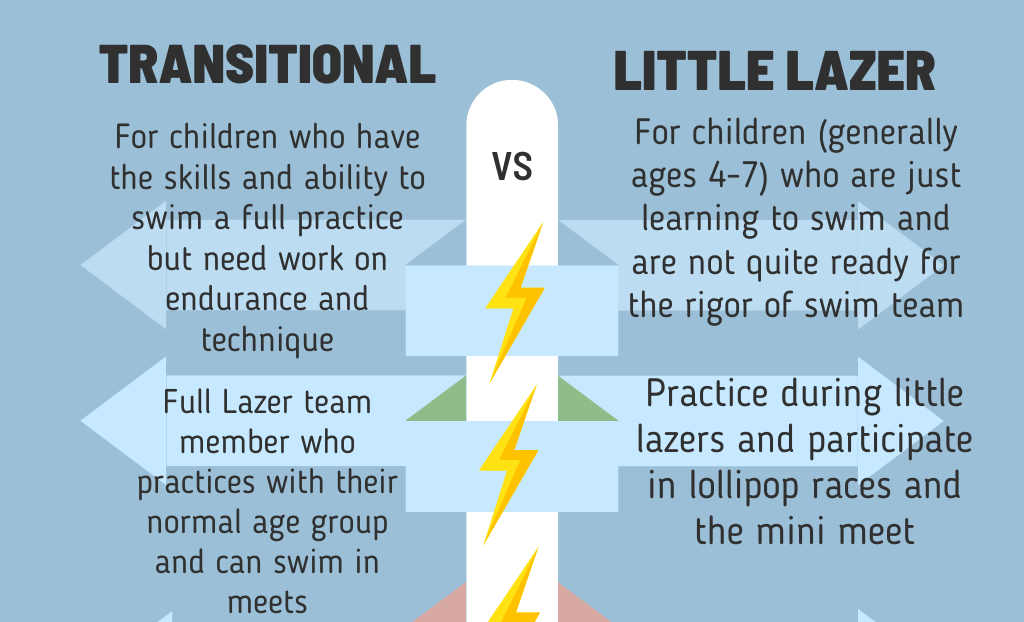
Transitional Swimmer Evaluations: Not sure if your child should be a Little Lazer or a full Lazer? Is your child too old for Little Lazers but wants to start swimming later in life? We have a Transitional lane at practices just for these situations. We work on building endurance for kids who aren't ready for the full team, and kids graduate to the big kid team whenever they're ready. Coach Catherine & Coach Natalie will have your child get in the pool and show them what they can do and place the child within one of our programs. Please see email with sign ups for June 6 at 8:00 AM.
Summer, June 18 - July 24
Beginning Thursday, June 18, swimmers may attend morning practices. Little Lazer Practice will start Thursday, June 18th. Regular practices continue through July 24; Little Lazers practices go thru July 23 with a Mini Meet in the evening of July 23.
Morning Practices
Morning practices are held Monday through Friday by age group. These practices, since the pool is closed, provide the most focused instruction and team building time. If you child can possibly come during these practices, this is the best option. Transitional swimmers practice with their own age group just in a separate lane :)
7:45-9:00 am - 13 and up
9:00-10:00 am - 9-12 and transitional swimmers Ages 9-12
10:00 am 10:45 am 8 and under's
Little Lazers, 3 groups starting at 9:45 going in half hour intervals to 11:15, T/W/TH. Parents will sign up for these slots.
10:45 to 11:15 Tiny Lazers T/W/TH
Afternoon Practices
Morning practice is the primary practice time and we highly recommend that you try to make these practices. Only swimmers that are unable to attend the morning practices and registered for afternoon will be permitted at the afternoon practices. These practices for the Lazers on TWR from 5:30 - 7:00pm (11&up 5:30 - 7:00; 10&under and transitional 6:00 - 7:00pm) have to be requested as we have limited coaching and space as the pool is open to the membership. Also, many afternoon practices are stormed out - another great reason to make the morning practice. Little Lazers will have afternoon practice in 3 sessions, T,W,R 4:30-5, 5:30 - 6:00pm or 6:30 - 7pm - limited space available.
Practice Goals
Practice sessions focus on conditioning, stroke mechanics, starts, turns, and finishes. Swimmers are encouraged to set personal goals and then supported as they work to achieve them. Building team camaraderie, making friends, and good sportsmanship are also important goals.


Training Groups
Training Groups are formed by age, not speed or stamina. This promotes team unity and proper age-related activities.
NOTE: Your child's age as of June 1st determines their Age Group for the summer.
Little Lazers
For children (generally ages 4-7) who:
- are comfortable in the water
- will put their face in the water
- maybe go under water
- will follow instructions to try new things.
- are not quite ready for the rigor of swim team
- are interested in learning the strokes and “being on the team”.
Little Lazers are also encouraged to come to our home meets and participate in the Lollipop Kickboard Race. They practice for 30-minute sessions. Goals are to refine their stroke so they can swim the length of the pool without touching the sides and breathing correctly. We also work on swimming the backstroke successfully. Children learn how to float, use a kickboard, and take a few breaths without stopping. Goals vary for each child, but ultimately we strive to get them swimming the freestyle stroke up to a length of the pool.
Tiny Lazers Parents and Me
Tiny Lazers is our newest practice group. It is for 2 and 3 year olds and a parent or caretaker, along with at least 1 coach per 2 Tiny Lazers. We help the little ones get used to the water and play fun games and we ask the parents to help out to keep our youngest swimmers comfortable. Sign up and payment is per session and will be posted just before or soon after the season starts.
Other Age Groups
8 & Under
These children (generally aged 7-8) have some experience with all strokes and are working on doing them legally. We teach them about the swimming rules and sportsmanship and what getting a Personal Best means. They swim 25m (one length of the pool) in the meets. We celebrate their accomplishments. Our goal is to focus on getting them to swim each stroke legally. This is a very developmental sport, so try is the operative word.
9 & 10
These swimmers graduate to swimming 50m (2 lengths of the pool), and it is quite an accomplishment. Beyond continuing to work on technique, we add flips and turns to their repertoire. We increase the laps they swim to build up endurance and encourage goal setting and personal bests. We continue to discuss the rules of swimming and sportsmanship.
11 & 12
These swimmers are now usually experienced 50m swimmers. At this age, we start to refine their stroke and breathing to make it more efficient and hopefully faster. We make the main word for these swimmers--TECHNIQUE. Coaches will often pull them from their lane to do specific drills that will propel them to their next level.
13 & 14
These swimmers often have the most unrealized potential of every group. Sometimes with this age group, practice is seen as optional by the swimmer. Missing practice leads to not improving and makes meets much harder. Please encourage your athlete to prioritize swimming! Coaches are standing ready to help them swim their best, but they have to come!
15 & 18
Most often, these races are the rallying cry for our team. All the swimmers gather around to watch the big kids splash through the water with uncanny ease and few strokes. These swimmers are often the leaders on the team and are called on often to assist the coaches with tasks.
USA Swimming 101
THE FOUR STROKES
The four competitive swimming strokes are freestyle, backstroke, breaststroke and butterfly. The combination of all four strokes is called individual medley.
In freestyle events, the competitor may swim any stroke. The stroke most commonly used is sometimes called the crawl, which is characterized by the alternate stroking of the arms over the surface of the water surface and an alternating (up-and-down) flutter kick.
Backstroke consists of an alternating motion of the arms with a flutter kick while on the back. On turns, swimmers may rotate to the stomach and perform a flip turn and some part of the swimmer must touch the wall. The swimmer must finish on the back.
The breaststroke requires simultaneous movements of the arms on the same horizontal plane. The hands are pressed out from in front of the breast in a heart shaped pattern and recovered under or on the surface of the water. The kick is a simultaneous somewhat circular motion similar to the action of a frog. On turns and at the finish, the swimmer must touch the wall with both hands simultaneously at, above or below the water surface.
Some consider the butterfly to be the most beautiful of the strokes. It features a simultaneous recovery of the arms over the water combined with an undulating dolphin kick. In the kick, the swimmer must keep both legs together and may not flutter, scissors or use the breaststroke kick. Both hands must touch the wall simultaneously on the turns and the finish.
The individual medley, commonly referred to as the IM, features all four strokes. In the IM, the swimmer begins with the butterfly, then changes after one-fourth of the race to backstroke, then breaststroke and finally freestyle.

